.png)
The Ultimate Guide to Egg Size for Pregnancy and Conception

When you're trying to conceive, one of the most important things your doctor will look at is the size of your ovarian follicles. For the best chance at a successful pregnancy, a follicle generally needs to reach 18-24 millimetres (mm) in diameter. This isn't just an arbitrary number; it's the key indicator that the egg inside is mature, healthy, and ready for fertilisation.
Why Egg Size Is So Important for Getting Pregnant
So, why all the focus on follicle size? Think of the follicle as a tiny, protective nursery for the growing egg. Just like a fruit needs time to ripen perfectly on the vine, an egg needs its follicle to grow to just the right size before it's ready to be released. This growth is a sign of true maturity and viability.
A mature follicle tells us the egg inside has finished its development and has the correct chromosomal makeup for a healthy embryo. If a follicle is too small, the egg is probably immature and simply not ready for fertilisation. On the other hand, if a follicle gets too large, it might mean the egg is over-mature or that it’s actually a cyst, both of which can reduce the chances of a successful pregnancy. This delicate balance is precisely why doctors monitor follicle development so carefully during fertility treatments.
The Science Behind Maturity
The link between a follicle's size and the quality of the egg inside is well-established. A healthy, large follicle shows it has responded properly to your body's hormonal cues, especially the Follicle-Stimulating Hormone (FSH). This hormonal conversation is absolutely essential for the egg's final, crucial maturation stages.
The optimal follicle size isn't just a number; it represents a biological green light, signalling that the egg inside is chromosomally sound and prepared for the journey ahead.
Data from fertility audits in India strongly supports this connection. Clinical studies consistently show that eggs from follicles measuring 18-20 mm at ovulation give a significant boost to pregnancy chances by ensuring the egg is perfectly mature. Smaller follicles, however, can be a red flag. Some research suggests they can be linked to a 35% greater likelihood of chromosomal issues like aneuploidy in Indian women.
To get a better sense of how follicle size directly impacts your chances of getting pregnant, this table breaks it down.
Follicle Size and What It Means for Conception
This quick guide helps connect the dots between the measurements you see on an ultrasound and what they mean for your fertility.
Follicle Size (mm) | Egg Maturity Level | Typical Pregnancy Potential |
|---|---|---|
Below 10 mm | Immature | Very Low - Follicles are still in the early growth phase. |
10-14 mm | Developing | Low - The egg is not yet mature enough for fertilisation. |
15-17 mm | Nearing Maturity | Moderate - Getting close, but not yet at peak fertility. |
18-24 mm | Mature (Optimal) | High - This is the ideal "fertile window" for conception. |
Above 25 mm | Potentially Over-mature or Cystic | Lower - The egg may be past its prime, or it could be a non-viable cyst. |
Seeing these numbers helps put your cycle into perspective. The goal is to time everything perfectly to catch that 18-24 mm window.
While size is a fantastic indicator, it’s only part of the story. The overall health of the egg is just as critical. For a deeper dive into this, you can read our practical guide to egg quality improvement to learn about supportive lifestyle and nutritional strategies. In the end, tracking follicle size gives you and your doctor a vital window into your ovulation timing and overall fertility potential.
Finding the "Fertility Sweet Spot" for Follicle Size
When you're trying to conceive, timing and size really are everything. Fertility experts often talk about a "fertility sweet spot"—a specific size range where a follicle is most likely to hold a mature, healthy egg. Hitting this optimal window gives you the best possible chance of successful fertilisation and, ultimately, a healthy pregnancy.
The magic number everyone looks for is a follicle size between 18 millimetres (mm) and 24 mm. When a dominant follicle reaches this diameter, it's a clear signal that the egg inside is ready. It has finished its final growth spurt, is chromosomally sound, and is perfectly primed for ovulation, whether you're trying naturally or with help from treatments like IUI and IVF.
Why This Range Matters So Much
Think of the 18-24 mm range like a perfectly ripe piece of fruit. Follicles that are too small or too large just don't have the same potential for success, and here’s why:
Smaller Than 16 mm: These follicles are generally seen as immature. The egg inside simply hasn't had enough time or the right hormonal push to develop properly, which makes fertilisation a long shot.
Larger Than 25 mm: In this case, bigger isn't better. An oversized follicle might mean the egg is "post-mature," and its quality has started to decline. It could also just be a fluid-filled cyst without a viable egg inside.
This timeline helps visualise the journey of a follicle as it grows and works its way towards this all-important fertile window.
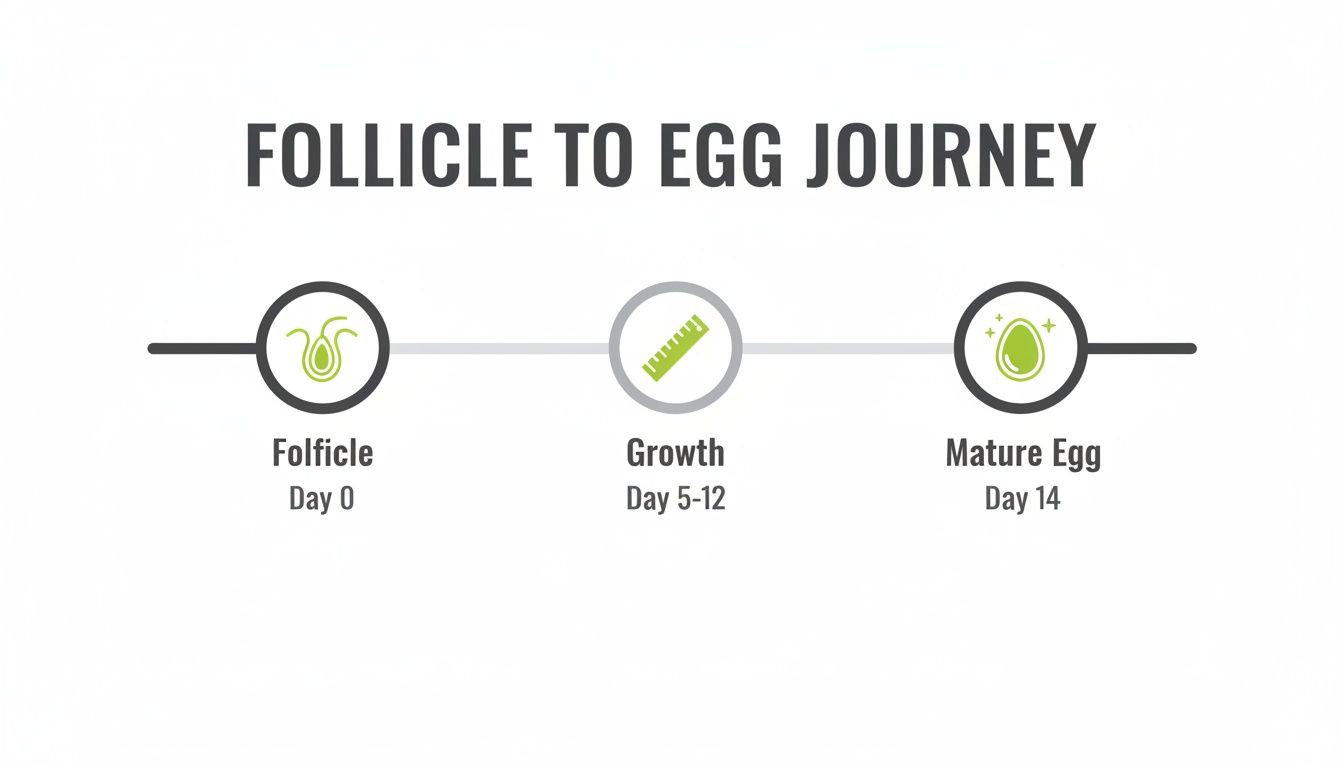
As the graphic shows, a follicle needs that steady, consistent growth to reach its peak right around day 14, which is when ovulation typically happens for many women.
What We See in Clinical Practice
This ideal range isn't just a textbook theory; it's backed by years of clinical experience. Data from IVF centres across India has long confirmed that follicles in the 18-22 mm range are the gold standard for success.
Once a follicle gets past the 12 mm mark, doctors typically see it grow at a steady pace of about 1-2 mm per day, usually hitting that sweet spot around day 13 or 14 of the cycle.
Knowing this target can feel incredibly empowering. It transforms what can feel like a complicated medical process into a clear, understandable goal. When your doctor does an ultrasound, you’ll know exactly what they’re looking for. You can take things a step further and feel more in control by learning how to decode your normal follicular study report.
The whole point of follicular monitoring is to pinpoint the exact moment your dominant follicle enters that 18-24 mm sweet spot. This allows for perfectly timed intervention—whether that’s natural intercourse, an IUI procedure, or an IVF trigger shot—to give you the absolute best chance of conceiving.
How Doctors Track and Measure Follicle Development
When you're trying to conceive, timing is everything. But how do doctors figure out the perfect moment? They don't just guess. Instead, they use a highly precise process called follicular monitoring, which gives them a real-time window into what's happening inside your ovaries. Think of it as getting a personalised, detailed map of your cycle as it unfolds.
The gold standard for this is the transvaginal ultrasound. While the name might sound a bit clinical, it's a simple and painless procedure. By using a small, specialised probe, your fertility specialist gets a close-up, high-resolution view of your ovaries—far clearer than what a standard abdominal ultrasound can provide. This level of detail is crucial for accurately measuring the tiny follicles as they grow.
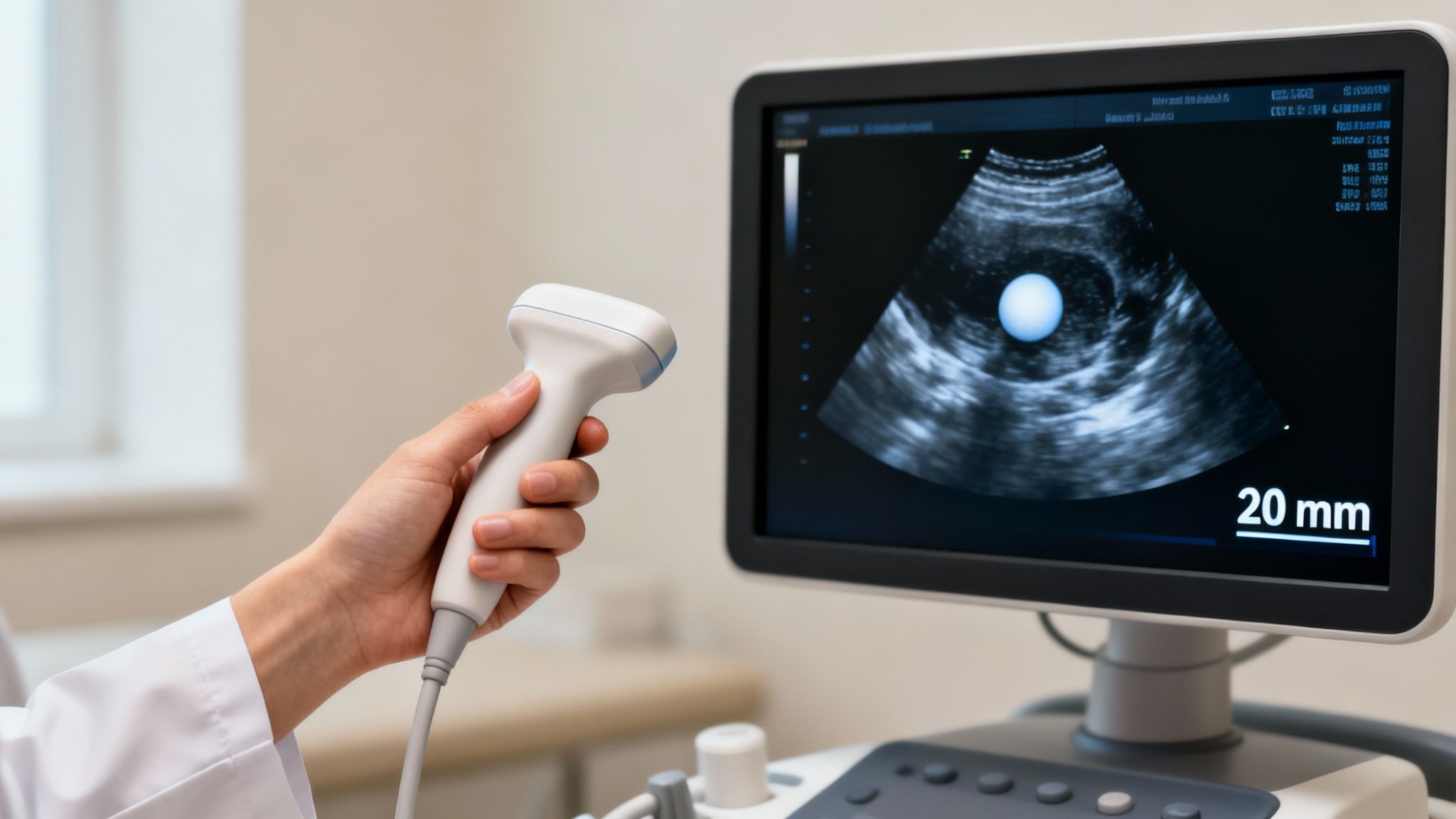
What a Typical Monitoring Schedule Looks Like
Follicular monitoring isn't just a single appointment. It’s a series of scans designed to track the progress of your follicles over several days.
Typically, your first scan might be scheduled around day 10 to 12 of your menstrual cycle. After that, you'll likely come in every two or three days. This regular check-in allows your doctor to watch the growth rate closely and spot the dominant follicle—the one that’s getting ready to release a mature egg.
It's About More Than Just Size
During these scans, your doctor is gathering several pieces of the puzzle to see the full picture of your fertility. They aren't just measuring the diameter of the biggest follicle.
Your medical team is also assessing:
The Number of Follicles: Looking at how many follicles are developing gives a good indication of your ovarian response, especially during stimulated cycles.
Growth Rate: A healthy, dominant follicle should be growing at a steady pace of about 1-2 mm per day. Tracking this confirms everything is on the right track.
Endometrial Thickness: The ultrasound also measures the lining of your uterus (the endometrium). For an embryo to implant successfully, this lining needs to be thick and receptive.
By putting all this information together—the follicle’s size, its growth pattern, and the condition of your uterine lining—your doctor can pinpoint your most fertile window with incredible accuracy. This is the key to perfectly timing intercourse, IUI, or the trigger shot for IVF.
Key Factors That Influence Egg Health and Follicle Growth
Getting a follicle to that perfect size for pregnancy isn't just a matter of luck. It’s a delicate dance between your body's internal rhythms, your hormones, and even your daily habits. Think of it this way: several factors can either help this process along or, unfortunately, get in the way, affecting not just the size but the all-important quality of the egg inside.
One of the biggest players here is age. It's a simple biological fact that as we get older, our ovarian reserve—the pool of potential eggs we have—starts to shrink. But it's not just about the number. The quality of the eggs that remain can also decline, which can make it a bit tougher for follicles to mature properly and hit that ideal size.
The Critical Role of Hormonal Harmony
Your hormones are essentially the directors of your reproductive system. Everything hinges on a finely tuned balance of hormones like Follicle-Stimulating Hormone (FSH) and Luteinising Hormone (LH). These are the chemical messengers that tell your ovaries it's time to grow a follicle and release a mature egg. If this hormonal symphony is out of tune, the whole cycle can stumble.
A classic example of this is Polycystic Ovary Syndrome (PCOS). This condition can throw hormonal balance into chaos, often preventing follicles from maturing all the way. You might end up with lots of small follicles, but none of them quite make it to the size needed for ovulation. In India, where PCOS impacts around 20% of women of reproductive age, this is a very common hurdle on the path to pregnancy.
Fertility specialists in India are clear on this: an egg needs to come from a follicle that's at least 18-20 mm to have the best shot at a successful pregnancy. Why? Because eggs from smaller follicles are often immature and can have a higher risk of chromosomal abnormalities, which sadly can increase the chance of early pregnancy loss by up to 50%.
How Your Lifestyle Shapes Your Fertility
It might surprise you just how much your day-to-day life influences your reproductive health. The choices you make every day can either create a supportive environment for your follicles to flourish or make their job a lot harder.
Here are a few of the big ones to keep in mind:
What’s on Your Plate: A well-rounded diet, packed with antioxidants, vitamins, and minerals, literally provides the raw materials for healthy eggs. Nutritional gaps can directly impact egg quality.
Managing Stress: When you're constantly stressed, your body pumps out cortisol. This stress hormone can seriously interfere with the reproductive signals from your brain, sometimes disrupting or delaying ovulation.
The Power of Sleep: Good, restorative sleep is non-negotiable. It’s when your body regulates hormones and repairs cells—two processes absolutely essential for maturing healthy follicles.
Environmental Factors: We’re surrounded by chemicals in everyday products, and some of these can act as endocrine disruptors, messing with your body’s natural hormonal flow.
By getting a handle on these influences, you can start making proactive choices that support your fertility from the ground up. As you start to make these positive changes, using this detailed pregnancy preparation checklist can offer a great framework for getting your body truly ready for conception. When you focus on these areas, you're creating the best possible environment for your follicles to thrive, grow to a healthy size, and ultimately release a top-quality egg.
An Ayurvedic Approach to Nurturing Your Fertility
While modern medicine rightly focuses on the specifics of measurements and timing, the ancient science of Ayurveda offers a beautifully complementary view. It sees fertility not just as a mechanical process, but as a direct reflection of your body's overall vitality and balance.
This timeless wisdom encourages us to look beyond just the egg size for pregnancy and instead focus on creating the best possible internal environment for conception. It's about nurturing the entire reproductive system from the ground up.
At the very heart of Ayurvedic fertility is the concept of Shukra Dhatu, which we can think of as the body's reproductive tissue. In Ayurveda, Shukra Dhatu is considered the most refined and potent essence of all our bodily tissues. Its health is the cornerstone of fertility for both men and women, directly shaping the quality of sperm and, of course, our eggs.

Nourishing Your Shukra Dhatu
So, how do we support healthy follicle development and improve egg quality from an Ayurvedic perspective? The focus is on strategies that nourish Shukra Dhatu from within. This isn't a quick fix, but a gentle, gradual process of bringing your entire body back into a state of harmony.
The goal is to create a fertile ground where healthy eggs can naturally mature and thrive. It often involves simple yet powerful changes:
Mindful Nutrition: Favour warm, cooked, and easily digestible foods. Try to limit processed items, excessive caffeine, and very cold foods that can dampen your digestive fire (Agni), which is essential for building healthy tissues.
Stress Management: We all know chronic stress throws our hormones out of whack. Practices like yoga, meditation, and pranayama (breathing exercises) are incredible tools for calming the nervous system and creating a sense of balance that is so conducive to fertility.
Herbal Support: Ayurveda has a rich tradition of using powerful herbs known as rasayanas (rejuvenators). These herbs specifically target and nourish the reproductive system, helping to regulate hormones and enhance egg quality.
Ayurveda teaches that true fertility comes not just from a single mature follicle, but from a body that is balanced, nourished, and free from stress. It’s about cultivating vitality from the inside out.
Bridging Ancient Wisdom with Modern Needs
What’s fascinating is how this ancient approach aligns so perfectly with our modern understanding of reproductive health. For instance, the Ayurvedic emphasis on reducing stress is directly supported by medical findings that high cortisol levels can interfere with ovulation.
Similarly, a nutrient-rich diet is a cornerstone of both traditional and modern fertility advice. You can dive deeper into this connection in our guide to holistic infertility treatment with Ayurveda for natural conception.
This philosophy is the very foundation of supplements like JJ Herbals' Success Plus. It incorporates powerful Ayurvedic ingredients, such as Mucuna Pruriens, which has been traditionally used for centuries to support hormonal harmony and reproductive vitality. By combining these time-tested herbs with essential vitamins and minerals, it offers a holistic way to nourish your Shukra Dhatu.
This approach helps create that optimal internal environment, supporting your body’s natural ability to develop healthy, mature follicles. It’s about building a strong foundation for fertility, one that nurtures your whole being to prepare you for a healthy pregnancy.
Common Questions About Egg Size and Conception
When you're trying to conceive, the world of fertility can feel full of technical jargon. Follicle measurements, trigger shots, egg quality... it's a lot to take in. But understanding what these numbers actually mean can make the journey feel a whole lot less intimidating.
Let's clear up some of the most common questions we hear about follicle size and what it means for your chances of getting pregnant.
Can I Get Pregnant With a Follicle Size of 15 mm?
It's not impossible, but it's very unlikely. Think of a follicle as the protective home where an egg is growing. At 15 mm, it's almost ready, but the egg inside hasn't quite reached its full potential for successful fertilisation. It’s like picking a fruit just before it’s perfectly ripe—it might be okay, but it won’t be at its best.
Trying to conceive with an egg from a smaller follicle, unfortunately, comes with a higher risk of chromosomal issues and even early pregnancy loss. That’s why fertility specialists nearly always wait until a follicle hits at least 18 mm. This ensures the egg has the best possible chance of leading to a healthy, viable pregnancy.
An egg's journey to maturity is a precise biological process. Waiting for the follicle to reach that optimal size isn't just about timing; it's about giving the egg the best shot at being high-quality and developmentally ready.
Is It Better to Have Many Small Follicles?
Not really. On an ultrasound, seeing lots of small follicles can be a good sign of a strong ovarian reserve, especially for women with conditions like Polycystic Ovary Syndrome (PCOS). It tells you that you have a good supply of potential eggs waiting in the wings. However, when it comes to getting pregnant, quality always trumps quantity.
For conception to happen, one of those little follicles needs to step up, become the "dominant" one, and grow to a mature size of 18-24 mm. If all the follicles just stay small and underdeveloped, you might not ovulate at all. Or, if you do, the egg that's released might be of poor quality. The main goal of many fertility treatments is to encourage one or two of these promising follicles to mature fully and release a top-quality egg.
How Long Does It Take to Improve Egg Quality?
Improving egg quality is a marathon, not a sprint. This is a crucial point to understand: the egg you ovulate this month actually started its final maturation process about 90 days ago. That three-month window is when the egg is most influenced by its environment—your body.
This means any lifestyle changes, dietary improvements, or supplements you start today will really show their effects on the eggs that will be ready in about three months. You're essentially creating a healthier environment for your future eggs to develop in.
It takes time for your body to build up the resources needed to support healthy follicular development. Consistency and patience are your best friends here; you’re laying the foundation for healthier eggs in your upcoming cycles.
Is a Bigger Follicle Always a Better Follicle?
Definitely not. There’s a sweet spot for follicle size, and bigger isn't always better. The ideal window for peak fertility is when a follicle is between 18 mm and 24 mm. Once it gets much larger than that, say over 25-28 mm, the quality of the egg inside can start to decline.
An oversized follicle might mean a couple of things. The egg inside could have become "post-mature"—it's past its prime and has a lower chance of fertilising. In other cases, a very large follicle might actually be a functional cyst that doesn’t contain a viable egg at all.
This is exactly why careful monitoring with ultrasounds is so critical during fertility treatments. The goal is to catch that perfect moment when the follicle is at its peak—mature and ready to go—before it gets too big and loses its potential. It's all about timing.
At JJ Herbals, we understand that nurturing your body is the first step towards a healthy pregnancy. Our Success Plus supplement is designed to support your reproductive health holistically, aligning with the timeless wisdom of Ayurveda to help you create the ideal internal environment for conception. Explore our natural, farm-to-bottle solutions at https://www.jjherbals.com.
Comments