.png)
Decoding Your Normal Follicular Study Report

A normal follicular study report is fantastic news. It tells you that your body is right on track—an egg is maturing properly in your ovaries, and your uterus is getting ready for a potential pregnancy. Think of it as a biological thumbs-up, showing that your reproductive cycle is working just as it should and giving you a clear guide to your most fertile days.
Your Fertility Roadmap: Making Sense of the Report
Getting your follicular study report can feel a bit overwhelming, like you've been handed a document full of complex medical jargon. But let's reframe that. Instead of a scary medical chart, think of it as your own personal fertility roadmap. It tells the story of your cycle, tracking an egg’s journey from a tiny, resting follicle all the way to its release at ovulation.
So, when your doctor glances at it and says everything looks "normal," what does that actually mean? It means all the key events in your cycle are happening right on schedule. It’s a sign that the delicate hormonal dance that governs your menstrual cycle is perfectly in sync.
A normal follicular study report is essentially a green light from your body. It confirms that the basic mechanics of ovulation are working correctly, which is the most fundamental step on the path to getting pregnant.
This series of ultrasound scans gives you a powerful look into your reproductive health by keeping a close eye on two main players:
The Follicle's Journey: The report tracks how the follicles in your ovaries are growing. Picture it like watching a flower bud develop. A normal report will show at least one of these follicles pulling ahead of the pack, becoming the "dominant" one, and growing steadily day by day.
Preparing a Welcoming Home: At the same time, the study measures the thickness and quality of your uterine lining, the endometrium. This is like preparing nutrient-rich soil for a seed. A healthy, plush lining is crucial for an embryo to successfully implant.
Ultimately, a normal follicular study report takes so much of the guesswork out of trying for a baby. It pinpoints your most fertile window with incredible precision, helping you and your doctor time intercourse or treatments to give you the best possible chance of conceiving. Understanding these two core elements is the key to decoding the specific numbers and terms you’ll see on your report.
Tracking the Follicular Growth Journey
Think of your follicular study report as a story unfolding day by day. It's a bit like a race where several runners start, but only one is destined to win. This journey tracks the development of your follicles—the tiny sacs in your ovaries that hold immature eggs—to pinpoint the exact moment of ovulation.
Getting a handle on this timeline is the key to understanding a normal follicular study report. This isn't something that happens overnight; it's a carefully timed sequence of growth spurts and hormonal cues.
The Early Cycle: Lining Up at the Start
The story kicks off in the early days of your menstrual cycle, usually between Days 2 and 5. During this first scan, the sonographer is essentially taking a roll call of the antral follicles that have been recruited for this month's "race."
At this stage, they are all quite small, just a few millimetres each. Seeing a group of them is a great sign that your ovaries are getting down to business. Don't worry about the number; it's perfectly normal to see several small follicles. The real focus is on which one will eventually pull ahead of the pack.
This visual timeline gives you a great overview of how this journey progresses, from the early cycle all the way through the fertile window to ovulation.

As you can see, the report tracks two parallel processes: the follicle's growth and the thickening of the endometrium (your uterine lining). A normal report shows that these two are perfectly in sync.
Mid-Cycle: A Leader Emerges
Things get interesting around Days 6 to 8. One follicle starts to outgrow the others, establishing itself as the dominant follicle. This is the one that's preparing to release an egg. Your report will show this lead follicle getting bigger while the rest of the group starts to fade into the background.
From this point on, the dominant follicle grows at a steady clip, typically expanding by about 1 to 3 mm per day. This consistent growth is a fantastic indicator of a healthy, progressing cycle.
The Finish Line: Ready for Ovulation
The final scans are all about confirming when this star follicle reaches full maturity. For a follicle, the "finish line" is typically a size between 18 mm and 25 mm. Hitting this size is the signal that it’s ripe and ovulation is just around the corner—usually within the next 24 to 36 hours.
A mature follicle measuring over 18 mm is the clearest indicator in a follicular study that your body is ready to ovulate. It’s the peak moment the entire tracking process has been leading up to.
Getting these precise measurements is a science in itself. If you're curious about the technology behind how doctors measure things like follicle size and endometrial thickness so accurately from scans, you can explore medical image segmentation techniques. This technology is what gives doctors the high-confidence data needed to predict ovulation.
Why Endometrial Thickness Matters
While the growing follicle usually steals the spotlight during a follicular study, another crucial player is quietly setting the scene: the endometrium. Think of it this way: if the dominant follicle is the star of the show, the endometrium is the stage where the magic happens. Without a perfectly prepared stage, the performance simply can't go on.
This is exactly why a normal follicular study report meticulously tracks the measurements of your uterine lining. It’s not enough to just produce a healthy egg; your body also needs to create the perfect "nest" for a potential embryo to snuggle into and grow. Much like a gardener prepares the soil before planting a seed, your body readies the endometrium to welcome a fertilised egg.
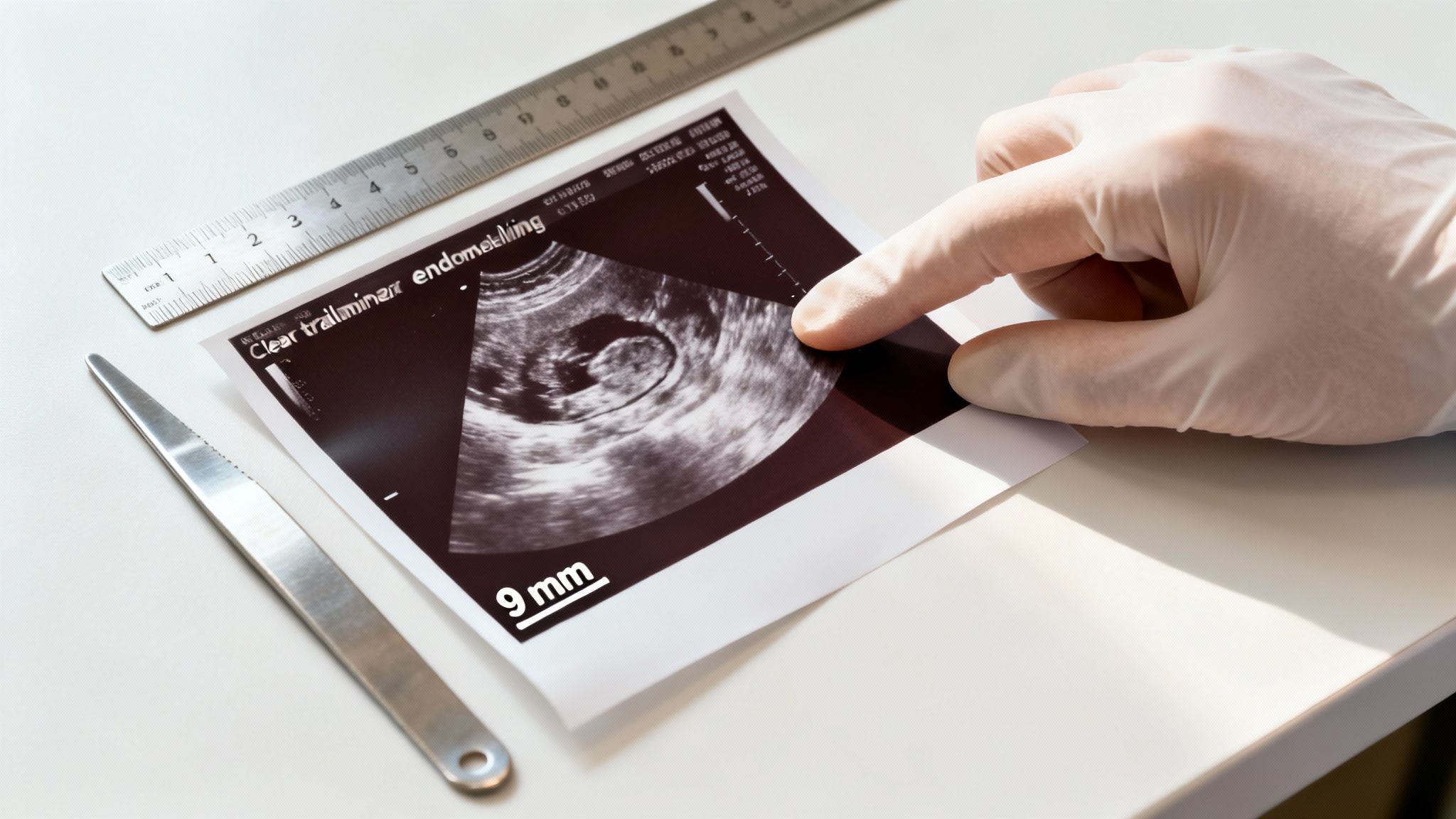
This preparation is a dynamic process, involving a significant transformation throughout your menstrual cycle.
Tracking Endometrial Growth
Right after your period ends, the uterine lining is at its thinnest—it might just look like a pencil-thin line on that first scan. This is completely normal. As your oestrogen levels begin to climb, thanks to the developing follicles, the endometrium gets the signal to start thickening and building itself up. Your follicular study report will chart this progress with every visit.
The aim is to see a nice, steady increase in thickness, creating a lush, welcoming environment full of nutrients. This ensures that if an embryo does implant, it has all the support it needs to begin its journey.
The Ideal Thickness and Pattern
As you get closer to ovulation, your report will zero in on two key features of the endometrium: its thickness and its pattern. Both give us vital clues about how receptive it is.
For the best shot at successful implantation, fertility specialists generally like to see an endometrial thickness of at least 8 mm around ovulation. While pregnancies can certainly happen with linings that are a bit thinner, this measurement is often seen as the ideal target. A lining over 8 mm suggests a healthy, well-nourished foundation.
You might come across the term "trilaminar pattern" in your report. This is a fantastic sign! It describes a distinct three-layered appearance on the ultrasound, looking like a triple line. This pattern is considered the gold standard indicator that the endometrium is perfectly primed and ready for implantation.
Here’s a simple timeline of what your doctor is looking for:
Early Cycle (Just after your period): The lining is thin, typically under 5 mm.
Mid-Cycle (Follicular Phase): It steadily thickens, adding a few millimetres.
Pre-Ovulation: Ideally, it reaches between 8 mm and 12 mm and shows that classic trilaminar pattern.
Ultimately, seeing a thick, trilaminar endometrium on your report is just as exciting as spotting a beautiful, mature follicle. It’s the confirmation that both essential parts of the puzzle are perfectly synchronised, paving the way for a potential pregnancy.
Understanding Your Antral Follicle Count
Beyond watching one follicle take the lead, your normal follicular study report gives us another vital piece of the puzzle: the Antral Follicle Count (AFC). Think of it as a snapshot inventory of your "egg bank"—your ovarian reserve—for that specific cycle.
This count happens during your very first scan, usually between days two and five of your period. The sonographer carefully counts all the small, resting follicles (typically 2-9 mm in size) they can see on both ovaries. This number is a powerful indicator of your fertility potential.
What Is a Normal Antral Follicle Count?
A good AFC is reassuring. It suggests your ovaries have a healthy supply of eggs waiting in the wings for future cycles. While there's no single magic number, a higher count generally points to a better response if you ever need fertility treatments.
On the other hand, a very low AFC might signal a diminished ovarian reserve, meaning the number of eggs ready for recruitment is lower. This absolutely doesn't mean you can't get pregnant, but it’s crucial information that helps your doctor tailor the best plan for you.
Your AFC isn't a final verdict on your fertility. Instead, it's a valuable predictor of your ovarian reserve. It's one part of a much bigger picture that allows your doctor to personalise your care and set realistic expectations.
AFC in the Indian Context
It’s so important to remember that "normal" can look different depending on where you are in the world. Research focused on Indian women has shown that the baseline AFC can naturally differ from what’s seen in Western populations.
For example, a significant study revealed that the average AFC among fertile Indian women was around 10 follicles. This is often lower than the averages reported in Europe or North America, which could be due to a mix of genetic, environmental, and lifestyle factors. This local context is vital; it means your doctor interprets your report using data that’s actually relevant to you, giving you a far more accurate and personalised assessment.
Knowing your AFC helps put the rest of your follicular study into perspective. While your focus might be on that one growing follicle, don't forget that the health of all your eggs matters. Supporting your ovarian reserve is key, and you can learn more about how to improve egg quality naturally in our comprehensive guide. Taking this holistic approach means you're nurturing your fertility from every angle.
Turning Your Report into Action
Getting a normal follicular study report is often a huge sigh of relief. It’s fantastic news, confirming that the fundamental mechanics of ovulation are working just as they should. But this report is more than just a piece of paper with good news; it’s a personalised roadmap, showing you the most direct route to conception. Its real power comes from using this information to take precise, well-timed action.
Instead of just crossing your fingers and hoping for the best, the report gives your doctor—and you—the data needed to strategically plan your next steps. All the guesswork is stripped away, replaced by a clear, science-backed timeline. This instantly shifts you from passively waiting to actively participating in your fertility journey.

Pinpointing Your Peak Fertile Window
The number one action to take after a normal report is all about timing. Your doctor will look at that final scan, see the mature, ready-to-go follicle (typically 18-25 mm), and predict ovulation with incredible accuracy. This usually happens within the next 24 to 36 hours. This is it—your peak fertile window.
Based on this precise prediction, your doctor will give you clear advice on the best days for intercourse. This takes the pressure off and dramatically increases the chances of sperm and egg meeting at the perfect moment, boosting your odds of conceiving naturally in that cycle.
Scheduling Assisted Reproductive Procedures
For couples using assisted reproductive technologies, a normal follicular report is the green light to get procedures on the calendar.
Intrauterine Insemination (IUI): If an IUI is part of your plan, the procedure will be scheduled to align perfectly with your predicted ovulation. The study ensures the sperm is introduced at the most opportune time.
Trigger Shots: In some situations, your doctor might suggest an hCG (human chorionic gonadotropin) trigger shot once a mature follicle is confirmed. This injection helps induce ovulation at a very predictable time, refining the timing even further for intercourse or IUI.
This is where follicular studies truly prove their worth. In India, their clinical value is exceptionally high; studies show follicular tracking can achieve an ovulation prediction success rate of nearly 90%. That level of accuracy is invaluable when planning your efforts.
The true power of a normal follicular study report isn't just knowing that everything is working—it's knowing when. It transforms your efforts from a game of chance into a well-timed strategy, significantly boosting your odds of success.
Considering Holistic and Long-Term Health
A positive report also gives you a great opportunity to zoom out and focus on your overall well-being. Supporting your body's natural rhythms can only help. Many people find immense value in complementary approaches, and you might want to look into how infertility treatment in Ayurveda can support reproductive health.
On top of that, since hormonal balance and fertility are so closely connected, it's a good time to be proactive about other aspects of your health. You might want to explore private thyroid testing to make sure all systems are running smoothly. Seeing your normal report isn't the finish line; it's the starting pistol for a focused, confident, and proactive next phase of your journey.
Common Questions About Follicular Studies
Even with a detailed report in hand, it’s completely normal to still have questions buzzing in your mind. A follicular study packs in a ton of information, but let's be honest, sometimes you just want a straight answer to a simple question. We’ve put together this section to tackle the most common queries we hear, hopefully giving you more confidence and clarity on your fertility journey.
Think of it as your go-to guide for all those "what if" and "is this normal?" moments. Our aim is to take the mystery out of the process and put your mind at ease.
Is the Follicular Scan Painful?
This is usually the very first thing people worry about, and the good news is, no, a follicular study shouldn't be painful. The whole thing is done using a transvaginal ultrasound (TVS). A small, lubricated probe is gently placed inside the vagina to get a clear picture.
While the sensation might feel a bit strange or mildly uncomfortable for a moment, it’s definitely not supposed to hurt. The scan itself is over in just a few minutes and is much less invasive than many other gynaecological procedures. It's simply the best and most accurate way for us to see what's happening with your ovaries and uterine lining.
Does a Dominant Follicle Guarantee Pregnancy?
Seeing that perfect, mature dominant follicle on the screen is a huge and exciting step! It’s a clear sign that your body is right on track and preparing for ovulation, which is absolutely essential for conception. But it's also crucial to have realistic expectations: a dominant follicle, on its own, doesn't guarantee a pregnancy.
Think of it as just one very important piece of a much bigger puzzle. For a pregnancy to happen, a whole cascade of events needs to fall into place just right:
Successful Ovulation: That beautiful follicle actually has to rupture and release the egg.
Egg Quality: The egg waiting inside that follicle must be healthy.
Sperm Health: Healthy, active sperm need to be present and ready to go.
Fertilisation: The sperm and egg have to successfully meet and create an embryo.
Implantation: Finally, that tiny embryo must travel down to the uterus and snuggle into the well-prepared lining.
A normal follicular study report is fantastic because it confirms the first critical step is going well, which definitely boosts your chances. But it's not the whole story.
What Happens If Ovulation Does Not Occur?
Sometimes, the scans might show that a mature follicle didn't rupture when it was supposed to. This is known as Luteinised Unruptured Follicle (LUF) syndrome—basically, the follicle grows but fails to release the egg. It's more common than you might think and certainly doesn't mean your journey has hit a dead end.
If this happens, your doctor will talk you through the next steps. A common approach is to use an hCG "trigger shot" in your next cycle. This injection is timed precisely to help induce ovulation, giving that mature follicle the final push it needs to rupture and release the egg.
It's so important not to jump to conclusions or worry if you see something unexpected on your report. Every cycle is unique, and your doctor is the only one who can properly interpret your results and tweak your plan.
Trying to figure all this out can bring up a lot of personal questions. If you're feeling unsure and need guidance that’s specific to you, the best thing you can do is talk to an expert. Scheduling a doctor consultation can clear up any confusion and give you a solid, tailored plan to move forward with confidence.
At JJ Herbals, we believe in empowering you with knowledge and supporting your wellness journey with natural, effective solutions. For more information on how our Ayurvedic supplements can complement your path to vitality, visit us at https://www.jjherbals.com.
Comments